Projects 2013 > "Little j" Hyper Local News > Journal
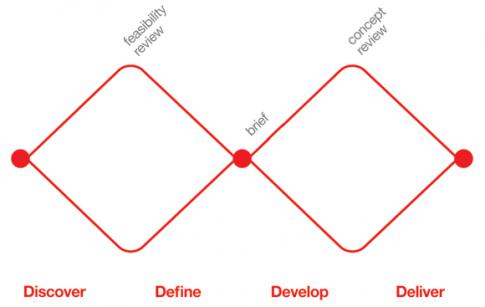
I'm used to the double-diamond approach to design (have a look here if this is new to you), I worked on several projects with the Design Council which adopted this strategy. It's definitely a healthy way to run a design-based project and allows for the project to shape itself through feedback and research. However, there's a tiny phase that people often don't mention that I think is useful to know so you can prepare yourself for it – the ‘have you seen this?’ phase.
It happens when you start talking about your project with others. Don’t get me wrong, it's very healthy to get people’s opinions but it often elicits comments such as: “Well that does sound great but have you seen this? It's very similar to the project you're proposing.” This is even more unnerving when you have done a lot of research and suddenly a new project pops to your attention which slipped through the net. Suddenly you’re filled with doubt that your project really has any substance or original purpose. If you’re not careful you could lose motivation to continue (and I have seen this happen to some very good projects).
So what’s come up in Little J’s ‘have you seen this?’ phase?
Facebook et al
A purpose of the project is to give people a platform where they can take part in their local news, so how is it different from Facebook, Twitter or any of the social networks? It’s a good point as we know from research that Facebook in particular is a very popular method of people sharing local stories or opinions. The Port Talbot Magnet has a very active Facebook page which the local journalists scour for reports of interest and interact with the community. However, there seems to be little motivation to share or focus in the social networks. When someone posts they do so openly to the group, not
Journatic
A controversion one this, but worth looking at. This was sold as a service to many large newspaper groups as a way of them sourcing (so-called) hyperlocal news, however it hid itself away from the public. I say so-called as it turned out that the hyperlocal news stories it sold weren’t so hyperlocal after all. In fact stories were often outsourced to freelance journalists all over the world, writing about local news hundreds of miles away. It was outed in the press and has since gone very quiet (here's an article from one of Journatic's own journalists).
What’s interesting here is that the service could exist at all shows that there is a need for hyperlocal news. Journatic thought they found a good method of creating the stories but was tripped up by its dishonesty. The positive for Little j is that it shows there is a market for hyperlocal news.
Patch
A US based service which gathers news and social comments for a particular area. For examples this is the Patch website for Laguna Beach in California > http://lagunabeach.patch.com/
There are actually quite a few sites that we have seen like this. In fact you could say that the Port Talbot Magnet is quite like this as it’s an area where they can distribute the news for their area. However, it deals with distribution of news, not the collection of it and this is where Little j would be a great resource for gathering higher quality stories from the local community.
Ushahidi
This is huge and has garnered a great deal of media attention (including a TED talk from its co-founder, Erik Hersman). It’s a GoogleMap mashup that originally allowed Kenyans to report and track violence via cell phone texts following the 2008 elections and has since evolved to become an open-source platform for anyone to use.
We have looked at this very hard and can learn so much from the structure. In fact we have created a Ushahidi powered site for Port Talbot and intend to use it on the ‘Little Day’ event in March (you can see the site here > http://littlej.borrowed-scenery.com ).
Ushahidi states that its mission is ‘to expand the power of everyday people to share vital news via text’. However, there’s no reason that the news has to be ‘vital’ or that the input method needs to be a text – the system would still work for everyday news and could open up all the possible channels. But by removing the ‘vital’ element of the news it removes the motivation for wanting to report it. People facing violence or unjust actions will be motivated to report such crisis data, will people with low-level news do the same? With Little j we hope to build it motivational structures to keep a community engaged with reporting the news, even if it’s just meaningful to people in their street.
---
Overall, the ‘have you seen this?’ phase of the project is often hard to get through but I believe that studying each project that crops up and refining your idea does make a stronger project at the end. Little j has moved and adapted along this journey and we are now taking the next step into developing the first real prototype.
Posted by Paul Davies