Projects 2013 > Orion: Behind the Mask > Journal
Our project has evolved from being about creating an on-line portal through which to crowdsource archive material from Orion fans into being a site, which extends and deepens the core themes of the film in new and exciting ways. This post will examine the processes that we have been through to reach this position, starting with our work with Tint and ending with our current project plan.
Tint is an on-line tool that embeds real-time hashtag searches from multiple social channels. It takes projects direct to the audience by using their preferred social media tools. We were pleased to receive agreement to use this software for a respectable fee that will take the project through to the launch of the film. Through our research, we have ascertained that Twitter and Facebook are the main social media used by the overwhelming majority of Orion fans, and so it made sense to ask people to send us their photos/stories/tributes by uploading with the hashtag to these two sites. Once we’d put out our call and also connected directly with our key ambassadors via e-mail and the phone, content miraculously started to appear on the dashboard. It's been an ongoing process keeping the site active but an exchange with and between our audience has definitely been triggered by the process. You can see for yourself by following this link: http://www.tintup.com/myorion
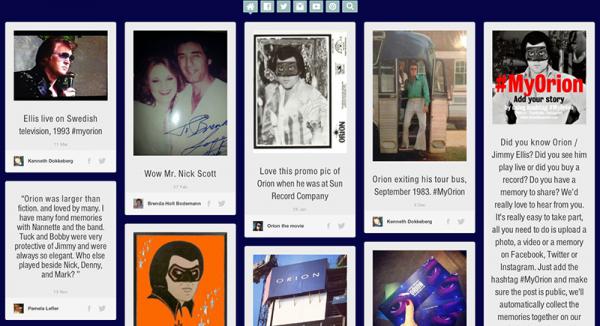
#MyOrion on Tint
It soon became clear that Tint was doing the job for which we had originally envisaged creating our own on-line portal. It was a simple ask which did not demand too much technical know how in order to be able to participate effectively. It was also the case that not everybody wanted to respond publically via Tint but that the call to action was a catalyst for further communication by phone, post and e-mail, which has led to additional archive materials being sourced. What matters is that our call to action stimulated interest and led to participation, if not always via Facebook, Twitter and Tint. This positive result freed us up to re-think the on-line work that we could develop with our technology partner, 383 Project. Had we rushed into protoyping too early, we would not have allowed our audience research to influence our design decisions and would have committed ourselves to imposing an over-complicated approach to a need for which we had now found a much simpler solution.
Back to the drawing board. At around this time, I presented the project to a group of artist friends, who made the point that what was driving this project was the film and that any on-line experience would necessarily be an ancillary activity. As an interactive documentary specialist, I was starting to dream up a concept for a first person on-line story experience in which the act of wearing a mask would trigger an augmented reality response and take the wearer into the underbelly of American life as seen through the eyes of Jimmy ‘Orion’ Ellis. All well and good, apart from the fact that our budget would not stretch to this and that Jeanie’s first priority was to secure financing for the film. Whilst not wishing to pour cold water on my ideas, it soon became clear that a simpler, less technology dependent solution would be more appropriate. With this in mind, our next step was to further research our proposed primary and secondary audiences to find out more about their interest in and connection with the Orion story.
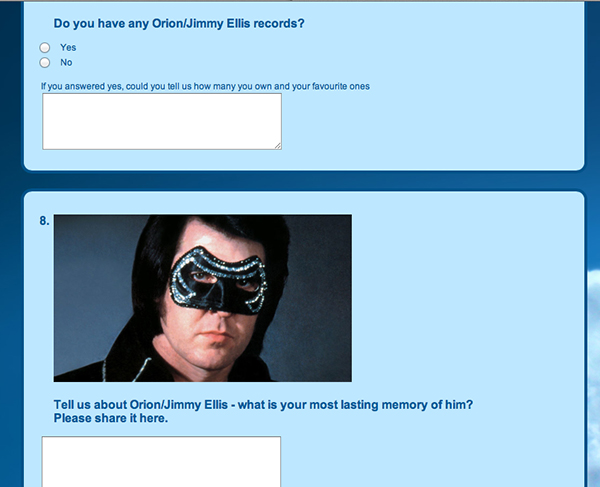
Questionnaire for Orion fans
Working with our fan studies advisor, Dr. Lucy Bennett, we devised two questionnaires, one aimed at Orion fans and the other at Elvis fans, and posted the call for responses on Facebook, Twitter and on our Tint dashboard. So far, we have received nearly 70 responses to the Orion questionnaire and over 30 responses to the Elvis questionnaire. These make it clear that both Elvis and Orion are remembered by their fans for being hugely talented, charismatic individuals possessed with a great voice, good looks and much generosity of spirit. In this sense there are definite similarities between the two men’s stories, with them both dying young and both having an air of sadness about them, in spite of their fame. However, whilst Orion fans seem generally keen that his story is going to be made more widely available, the response from Elvis fans has been more mixed. A recurring theme is that that no-one can come anywhere near to Elvis’ talent and that while Orion might have been one of the best tribute artists, he could never match ‘the King’. This does suggest that, whilst Orion fans are generally keen to see the film when it comes out, many Elvis fans may well not share this same degree of interest in the Orion story. Our response to this has been to think more broadly about our secondary audience and to focus on fans of Sun Records in general, as opposed to Elvis fans per se.
Another aspect that came from our audience research was the point made by Dr. Lucy Robinson, a popular culture expert with expert kowledge on the Elvis phenomenon. Her understanding is that people love (and continue to love) Elvis so much because he was authentic, a man who started with nothing and who lived the American dream. His story charts the story of the American music business and of the sexual revolution of the time. By offering people an alternative to the belief system of the church, he offered a form of escape from the predominant social mores of the time. She advised that this sense that Elvis was unique and special must be respected at all times, leading us to again think that high tech digital solutions which risk being ‘for the sake of it’ were not the correct approach to be taking. It was clear from our questionnaires that many Elvis fans do indeed feel this way and that Orion also touched his fans on a similar level. Coming from a pre-digital era, they both connected with their fans largely through their live appearances and we wanted to remain ‘true’ to this by creating an aesthetic that was in keeping with this spirit. We also both believe that in era of i-pod playlists and disembodied screens audiences want the sense of time, place and occasion that a great live performance can create. Bill Drummond (ex KLF and founder of the K Foundation, made this point in his interview for the Documentary film 'PressPausePlay' and continues to be a source of inspiration for my work.
Taking all these factors into account, we decided to go for a simpler low-tech response that privileged a non-digital hand-crafted aesthetic wherever possible. Whilst the IamOrion part of the website will allow people to wear a prepared digital mask, what we really hope they will do is download a 2d version to print out and wear or, even better, craft their own hand-made masks. With that I mind, Jeanie has designed a series of masks based on the Orion album covers, to represent the different eras of his music. We filmed our two tribute artists, Gewvis and Gordon Elvis, performing in a mask and these videos will be added for inspiration to the IamOrion section of the site. Whilst we are actively seeding ideas as to how these masks might be used into the various social media networks, we also expect to be surprised by the creative responses of our audience.
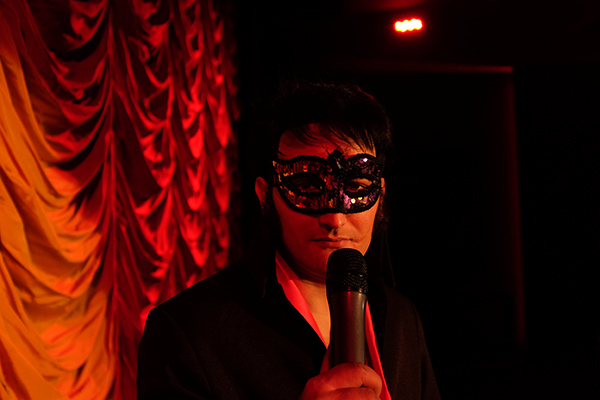
Gordon Elvis performing at Boadway Cinema - courtesy of Jeanie
As part of the search for archive materials, Jeanie and Sally also contacted every record shop in the USA asking if they had any Orion recordings or related memorabilia. This unearthed a box of original 8 track recordings in Nashville, which have been negotiated to be listed as desirable perks for the crowdfunding campaign, which has just gone live: link: http://igg.me/at/Orion/x/15825. Thus, wherever possible we are using digital technology as a means through which to mediate a sense of authenticity and encourage hand-crafted creativity as a response to our call to action. We believe that this is an appropriate solution to using technology to helping to facilitate audience engagement with the Orion story. Meanwhile, I researched film websites and on-line first experiences to help position and consolidate our approach. It was David Lynch’s website that stood out as being the most in keeping with his overall aesthetic, no surprise given that, as an artist/filmmaker, he insists on having full creative control over the design and implementation of his on-line work.

From davidlynch.com
Whilst Jeanie has always aimed to connect with her audience on a personal level, for example baking 300 vinyl cupcakes for a cinema of people, this is becoming harder to maintain as the international each of her work grows. It has always been a key aim for our REACT project to explore ways in which technology can be used to find creative and emotionally engaging solutions to this problem that can inform a roadmap for further projects. Only time will tell but we hope that we are putting the seeds in place to enable this to happen. In a similar way to Ken Loach’s My 45, we want to put our audience inside the picture to enable them to relate directly to the core themes of the story being told. A huge inspiration for me on this front was my own research into mask wearing. This culminated with me wearing a mask as an audience member for PunchDrunk’s innovative show: The Drowned Man: A Hollywood Fable and being selected to participate in a full day’s master class with their artistic director, Felix Barrett. As a result of this experience, it has become clear to me that mask-wearing can challenge our preconceptions and change the way that we behave towards others. I shall observe with interest, how our audience responds to our call to action through IamOrion, as the project develops in ways that we anticipate to be both predictable and at times utterly surprising.
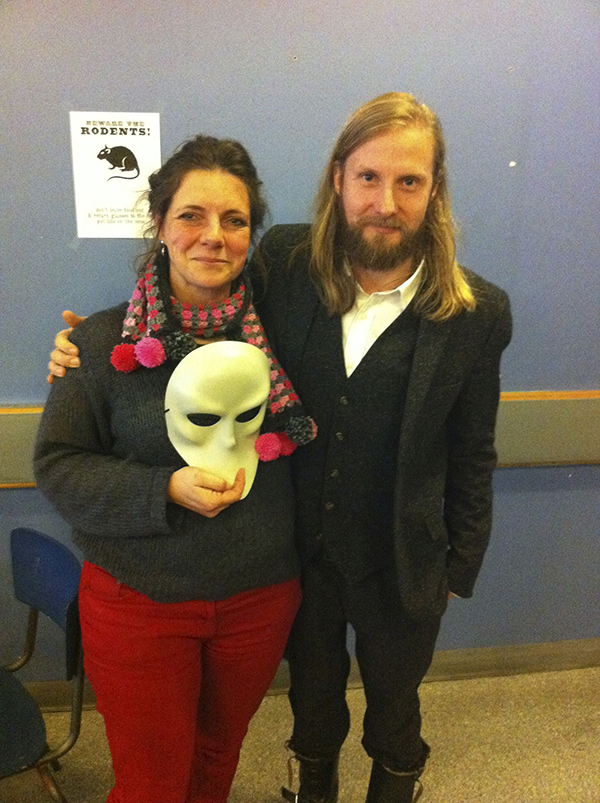
Me with Punchdrunk
Posted by Judith Aston