Projects 2013 > Quipu: Living Documentary > Journal
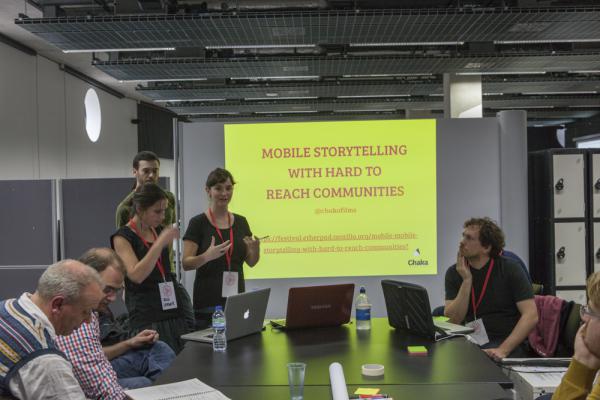
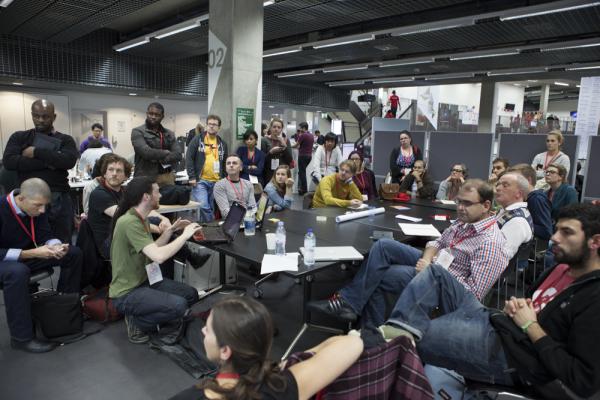
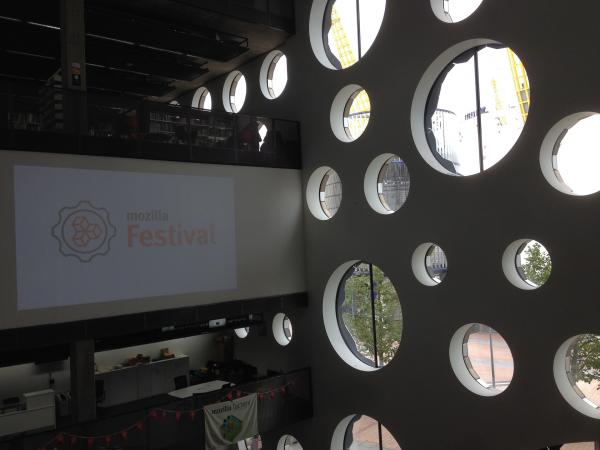
It was an exciting opportunity to participate in the Mozilla Festival with a workshop on the Quipu project, as for the first time we would take some of the ideas we've been developing for the last couple of months away from the safe grounds of the REACT Sandbox. The Mozilla Festival happens once a year in London and it is probably the main encounter of technology and open web culture. Rather than a traditional conference, where experts speak and audience listen, the Mozfest revolves around hundreds of workshops that take form across all 9 floors on the Ravensbourne University building throughout an entire weekend. Mozilla knows how to produce a context for people to collaborate and become part of the whole knowledge sharing experience in a way that is not common in other gatherings. Participants included experts and novices alike on wildly varied topics such as physical web, connected city, open data, education and mobile technology, through a shared approach that consisted simply on bringing ideas to the table and spending the weekend building prototypes.
Being the Mozfest driven by a strong technology ethos, we realized one of the distinct design challenges our project offered was to replicate the method we've used to develop technology with hard to reach communities. Our method is extremely simple: take as a starting point for developing technology the cultural conditions in which that technology would be used. For the Quipu project this set of conditions are given by a community of women who are geographically dispersed in remote areas all along the Peruvian Andes, with access to media only through radio and mobile phones and illiteracy as a determining factor that emphasized the role of oral culture. This set of constraints, become conditions of possibility if one is able to identify them at the beginning of the design process and allow them to feed the development work. In our case, this method led us to build a system of interactions based on audio across the digital divide using radio, mobile phones and web technologies. Still, the single most important factor that makes the project possible is the woman from Huancabamba having the will to share their personal and very intimate testimonies on how they were affected by the Health Policy applied by the Peruvian Government in the late 90's that ended in 300.000 forced sterilizations.
With this insight we kickstarted the workshop and groups formed rapidly around shared interests using the traditional post-it method, cornerstone of this kind of events. In fact, everyone who attended was closely aware or was currently working with some 'hard to reach' community so identifying a specific group and its conditions of possibility came out as a rather straight forward process. One group devised a skill share system between elderly people and the community at large, the other group focused on illegal immigrants brought into the country as sex slaves and discussed ways to make them visible and reach out for help without exposing them to further risk. Both groups developed specific systems of interactions to enable narratives that evolve through both new media and physical interactions. Yet, the question that became the core discussion around the table focused on the role of storytelling in these kind of projects. Why stories? Why should a community be encouraged to create their own stories? Should it be useful in some concrete way?
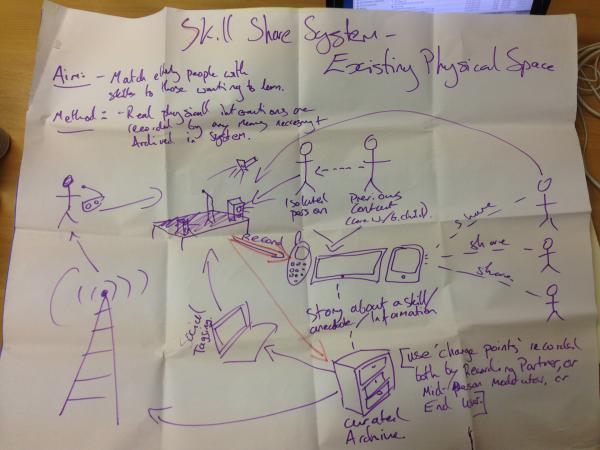
In this sense, one of the most inspiring insights produced during the day was how the role of storytelling can be described as simultaneous layers of story-driven strategies, being the traditional, yet certainly powerful emotional journey conducted through a narrative arch just one of them. For example, we are not usually aware how storytelling becomes part of our daily life as an explanatory force that literally helps us make sense of the world around us (Hayles, 2010). Constructing narrative models of our feelings and behaviours brings back causality and a sense of meaningful temporal sequence (Hayles, 2010). In simpler words, talking about it: helps. We've been able to experience this process during the initial test of the Quipu project. For the woman who participated in the first field test the main reason to engage with phone line was effectively to listen back to themselves telling their own story. I wouldn't go as far as claiming any healing or therapeutic properties of narrative in any direct form, yet we have been able to identify as an important participation driver the simple exercise of telling a story and hearing it back once and again, 'each time a bit better'. Making sense of their own experiences through a mobile device activates a storytelling layer beyond a pre-constructed narrative journey.
One final storytelling strategy we were able to identify that does not depend on the climax-structure we are so used to, is the very simple fact that stories are artefacts around which we love to gather around. Commenting on YouTube, gathering around a TV, going to the movies or having a "Fireside Chat" (as the Mozilla people love to rename conversations) have always been a collective endeavour around story. Participating of a narrative as it becomes alive brings a shared sense of purpose and collective drive. This is probably what we mean when we speak about the Quipu Project as a "Living Documentary", a kind of story that is not only presented to be consumed, but rather as a set of cultural and technological conditions that facilitate a story to happen, to grow into actually building its narrative threads as it goes along. The temptation at this point is to think about stories as having the ability to produce social change, yet we can then remind Werner Herzog's sobering words: "movies don't change anything, movies don't change the world, it's an exaggerated view".
What we are reminded thou is that storytelling, and specially storytelling with hard to reach communities, might be a purpose in itself, as it has the potential to provide meaning to daily life, to relations with others and to the stories we can tell about ourselves and collectively. Only then we might reach to what Herzog later adds, "movies don't change the world, but they might open your eyes".