Projects 2014 > Millie Moreorless > Journal
To recap Magnitude (Part i), Millie Moreorless is driven by a mathematical principle called 'Magnitude', which is the instinctive ability to discriminate between arrays of different quantity. Or, in plain English, it is the ability to recognise that 7 dots is more than 6 dots without counting them.
The theory is that this sense for magnitude is developed in childhood and underpins all subsequent mathematical ability. The research suggests that children with Down's Syndrome develop their magnitude sense more slowly than typically developing children, so we set out to come up with a fun, engaging game based around this concept to help them get better at it.
This seemed simple, but turned out to be very tricky!
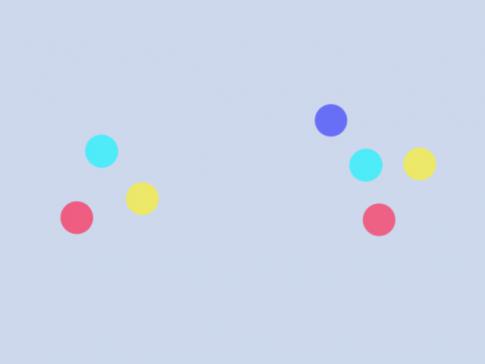
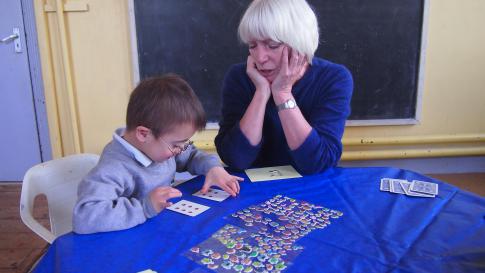
The simplest expression of magnitude is a choice between two arrays containing a different number of dots - which array is more? So to test magnitude sense, researchers basically show their subjects a series of cards containing two arrays with different numbers of dots and ask them which one is more. Over and over and over again. This is in fact how we started out working with our wonderful volunteers - to establish their 'base line' magnitude ability:
As the number of dots increases but the difference between them decreases, the choice gets harder. All other stimuli are suppressed so that you can be sure that the subject is only using their magnitude sense and no other clues - so the dots are plain and they always look the same and they are presented in a random, meaningless cluster.
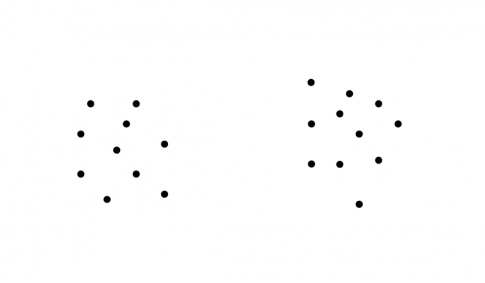
So at its simplest form, a game based on magnitude would be a series of choices between dots.
But is that really a game?
Is it fun? Will a player keep coming back to it? Will we be able to hold the attention of children with Down's Syndrome so that they truly learn?
All of our creative instincts screamed "no"! This is not a game; it's a dry research mechanic! It's the opposite of fun! We want to empower our players, not just use them to generate data!
So we thought about how to make this basic set-up into a game. We looked at rewards and scores and timers. We started out thinking about mice and traps, almost as a way of bribing the player to learn about magnitude while really their interest was on the traps.
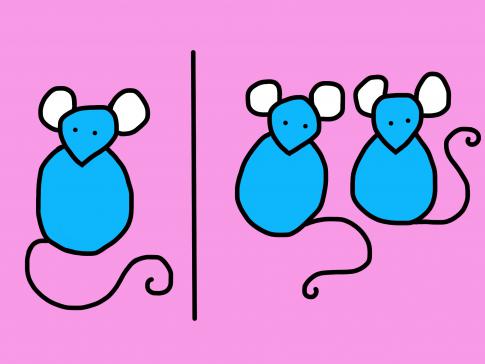
But this felt like a cheat. As we developed the concept, we realised that the magnitude choice wasn't driving the game, or even helping it - it was getting in the way of something much more fun!
So we threw away our lovely Mice of Mischief and went back to the drawing board...
We started to question everything. It became almost philosophical. The one thing that never changed was our stated aim: we were setting out to make a game for children with Down's Syndrome to help them get better at maths by developing their magnitude sense.
In other words, the array choice couldn't be hidden. It had to be at the centre, driving the game.
[To Be Continued]
Posted by Will Jessop