Projects 2014 > Teleportation Tent > Journal
I think we're at a good point with a month or so to go! So...
I’ll start with the experience as I see it now...
One day a package arrives at the front door ––– For now let’s ignore how the family become familiar with the product and the experience of purchase, which could be integral to the overall experience i.e. the child receives a letter even before the package arrives.
So, one day a package arrives at your front door. A suitcase that contains the means to go to other worlds. Within the suitcase contains a number of wooden poles, many little wooden objects, some fabric and a sealed envelope addressed to you.
You open the envelope and there’s a letter inside. You read the letter and it guides you through the construction of your Teleportation Tent and the installing of a golden box to the roof!
You finish off the construction and make it your own by gathering soft-furnishings and other objects from around the home that you want take on your adventures.
Your Teleportation Tent is set up, ready to go. You close the door, sit, and take a look around at your very own Teleportation Tent.
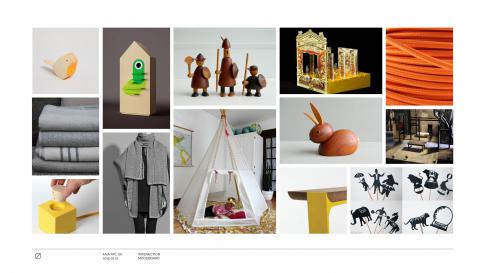
If you were to take it all in you’d notice, the tent looks like a teepee inspired by mid-century Scandinavian toys and furniture, like the works of Jacob Jensen and Kay Bojesen. You could imagine it being sold in Hay or Habitat, perhaps that’s where it was bought. It’s elegant and simple, white fabric lining the inside, with a light wooden structure holding it all together. There’s no varnish, perhaps the faintest hint of sanding sealer. Outside you remember the fabric being different, a white Herringbone, a subtle white on white weave.
Above you is the golden box hanging there, with a dark hole in the centre, currently you have little idea of what this box will do. The only other thing to note is close to the floor. Your eye can’t help but be drawn to a small stage 12 inches up one of the poles. Circular, with miniature floorboards, and what looks like cut-outs for placing something within, it feels like a miniature wooden theatre. There’s also what looks like a 'switch-that-doesn't-look-like-a-switch-thing' ––– I’m not sure what this is yet, something that is the on-switch, doesn’t need to be a button, tbd.
You switch the stage on, the stage glows, like how you may imagine a miniature victorian theatre to glow, a warm flickering endearing glow ––– I imagine this as a good thing, no cool lights or multi-colours and not vintage or nostalgic…
Then there’s a voice from the stage, you’re not quite sure who or what it is ––– I’m not sure yet either ––– but you’re guided to a secret compartment in your suitcase ––– Still working on this bit, could be key on the stage, a button on the stage, to unlock a secret bag or container in the suitcase, perhaps that you can only get to if you open the bottom of the suitcase, tbd.
Your greetings to the ‘unknown universe’ begins!
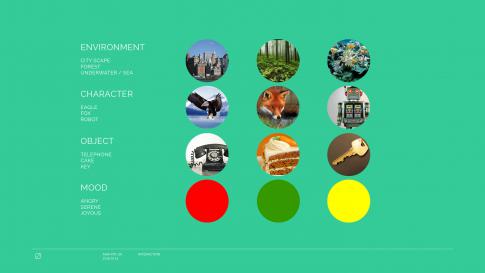
You’re greeted and encouraged to open the secret box that contains the characters (Fox, Eagle, Robot), objects (Key, Telephone, Cake), environments (Cityscape, Seascape, Forest) and moods (Serene, Joyous, Angry) that will take you on your adventure ––– all of the objects need a colour or shape identifier, so you know where to put what, tbd.
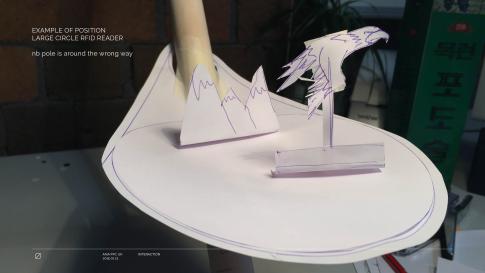
You then start taking control of your adventure. Focussing back on the stage you place an environment at the back of the stage, a character to stage-left and an object, stage-right.
Finally, you can incase your stage with the coloured mood dome, made from unbreakable glass (or Acrylic). it clicks into place and you’re greeted on the next stage of your adventure…
The Golden Box, that lay dormant above, comes to life. You are transported through audio and visuals ––– currently mixed media, of bespoke illustrations and filmic environments ––– that appear on all the surfaces of your Teleportation Tent, taking you to the world you’d chosen on the stage. You sit there ‘cruising’ ––– what we’re calling ‘vibing’ ––– through a new world, you kick back and relax.
Or perhaps not ––– this is an interesting part of the play-research with the kids, we discovered they started to use the environment like a catalyst for additional play. Play they make up. In our tests they created silhouettes out of card and made hand puppets to play with the visuals.
You have complete control over your stage. You can chose to go on another adventure at any point, by changing the arrangement on the stage ––– This is something else we’re playing with, how do we control (or perhaps we don’t) the time you spend in a world and how long you stay there, the affordances of the stage could be the key here.
Finally, you don’t feel like vibing anymore. You place the mood dome, environment, characters and objects back in your secret box. ––– depending on whether the tent is to be taken down fully, depends on what you want to do next, we’re still thinking about packing away and a’ that…
So, there’s a lot of decisions and design choices made to get to the above. We’re at a good point, it is now just a case of getting on and making the next prototype.
The tent prototype we have put together has been heavily informed by the play-research with the kids and the understanding of the environments the Teleportation Tent may well be played in. Most likely it will be played in the living room, or playroom, perhaps a bedroom. We took a bit of a guess at the size that felt right, based on the feedback from the kids and a few parents. The base is 1500mm in diameter, and around 1700mm tall. Enough space to allow 8 year olds to run in an out without hitting their head on the golden box.
Our simplified interaction came from the idea of Tarot cards and should be an elegant solution to choosing the adventure. We were considering gesture, and voice recognition, all through cameras inside the tent and I’m happy we’ve gone away from that.
All the above is based on the feedback and observation of the kids, but we haven’t yet tested that these solutions are the absolute right ones, we’ll just have to see. I’m quite excited about the detailing of the tent now, we’ve begun to consider quality of finish, the overall aesthetic, the consistency of visual language through objects, illustration and the ones associated with the tone of the story and user journey.
There has been a lot of chicken and egg, where we don’t know what comes first. Object inform story, story informs object, for example, and that has been the case for every consideration – changing an element, even slightly, has had a number of knock-on affects.
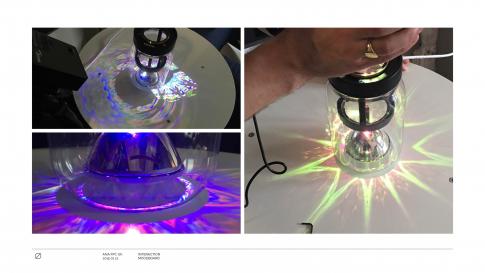
However, we’ve worked through this well and apart from not quite knowing how the projection will work – our projection expert has gone all quiet – we are creating the experience we think the project/product deserves and hopefully one the Play Sandbox kids will feel they had a hand in making…
More from me soon!
t.
Environment, Character, Object, Mood
Paper prototype of stage
Experiment with projections
Mood board of visual language - more here :http://www.pinterest.com/tommetcalfe/fpc-product-moodboard/