Projects 2014 > Millie Moreorless > Journal
When designing a game for a specific audience, clearly you need to profile that audience. What is it that gives them their identity, and how do you factor that in to the design?
Well, we're designing a game for children with Down's Syndrome. So their shared characteristics are that they're children, and they have Down's Syndrome.
Down's Syndrome is a genetic condition. It occurs by chance. There are no degrees of Down's Syndrome - either you have it or you don't. There is a common perception that people with Down's Syndrome are always "happy" or "full of love", but there is no reason that people who share a genetic condition should all have the same personality traits. So although our target audience all have Down's Syndrome, this doesn't mean they are all the same. Everyone is different.
Down's Syndrome comes with an associated learning disability, which can be anything from mild to moderate or even severe. That is to say that children with Down's Syndrome will all experience a level of learning disability, but some are more able than others. Scientific research, of which there is not a great deal, suggests that children with Down's find maths and numbers tricky - perhaps because it requires abstract rather than concrete thinking. This is why we are targeting this area with our game.
But whilst we know that we are making a maths game, the question of how to make its play accessible is much more tricky. We want everyone to be able to play the game, which includes those who are least able. So how do you cater for a player who might not be able to grasp the first rule of our game, which is that you have to choose more?
Maybe you make the game as simple as possible. Simple is good, right? But if it doesn't quickly become more challenging, you risk losing all of the more able players. There comes a point (and we've reached it repeatedly), where by over-simplifying you end up with nothing. And I believe firmly that sometimes you have to ask people to raise the bar. This is very much borne out by my experiences with the actors of Blue Apple Theatre. Who else would have believed that they could do this?
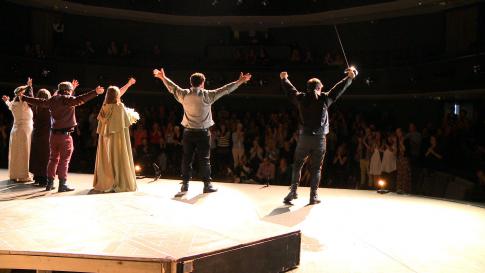
If you continually simplify something to take out everything you know someone can't do, then how can they learn to do it?
My brother Tommy and his fellow actors have convinced me that we're still exploring the true potential of people with Down's Syndrome. Part of the reason for this is that we have never given them the chance to achieve it.
So we want to make a game that is accessible to the least able player, but at the same time stretches them and allows them to develop and learn new things. The game also needs to become complex and challenging enough to keep the interest of more able players, because designing a game just for the least able player is no different from designing it only for the most.
The conclusion then is that we need a pacing and difficulty curve that adjusts to fit players of all different abilities.
And of course, because all of our players have different personalities, we need to try to find a visual design and story that everyone will like as well!
Not so simple after all...
Posted by Will Jessop