Projects 2014 > Millie Moreorless > Journal
One of the earliest decisions that we made about our game was that it would be based around the concept of “magnitude”. Jill explained the concept to Cara and me, and I'll do my best to remember what she said here! For some great further reading, please refer to Stanislas Dehaene’s book, The Number Sense.
Magnitude refers to our instinctive ability to be able to identify which of two groups of items (“arrays”) contains the greater number. So if one array has 99 apples and another array has 4 apples, most of us will be able to identify that the former is the greater without needing to count. Were it 99 apples and 98 apples, however, I think we’d all struggle – and perhaps even if we were allowed to count!
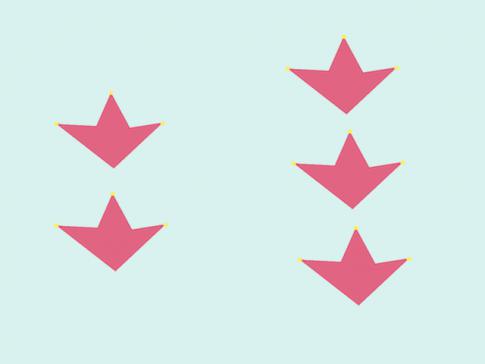
We develop this instinctive sense for magnitude very early on in our lives. Research suggests that a typically-developing 6 month-old baby can tell that 2 is more than 1, a one year-old can do 2 vs 3, a 2 year-old 3 vs 4 and so on. As the ratio increases it becomes more difficult, and about 10 vs 11 is the limit for your typical human adult (if there is such a thing!). That is to say that if an adult was presented with 11 raisins in one pile and 10 raisins in another, they’d probably be able to tell which was more without counting at least some of the time.
Sharp-eyed readers will have noticed that the choice of magnitude becomes harder when the quantities are large and the difference between them is small. So 10 vs 11 is hard, but 20 vs 400000 is not so hard. This is one of the two main reasons that it took us an awfully long time to come up with a great game idea based on magnitude. I'll explain in the next post!
Now, Dehaene's theory (see above!) is that this instinctive sense for magnitude underpins all of our subsequent numerical ability. This is a contentious theory, and more research needs to be done.
There is some even more limited research that suggests that children with Down’s Syndrome develop their instinctive sense for magnitude more slowly than other children. This raises the tantalising possibility that if we can help children with Down’s Syndrome get better at magnitude, then they might grow up to become adults with Down’s Syndrome who are better at maths.
Basic maths is a fundamental requirement of an independent life.
So by making a fun, addictive, exciting game to help young children with Down’s Syndrome get better at magnitude, we are really setting out to equip them with the skills to live a more independent and fulfilled life.
That’s our theory at least!
Here's some practice...